Tuesday, May 24, 2011

How to force your paper mill to produce electricity?

I'm sorry for the gap in adding new articles, but things to do had cumulated rapidly here and I had have to study for my final exams, which took part in the half of May...

But recently, I have found that scientists discovered an interesting and new method how to transform thermal energy into electricity! The new method is called lead telluride thermo-electrical device.


    Although it is not a new idea at all and many researches had done these devices before, they had never overcome a magical 10% line of efficiency whereas material scientists at the university of Illinois created a 14% one!
     That means that dirty factories could recycle 14% of their overall waste heat! And it was calculated that it IS definitely worth of it. Simply imagine that we could use waste energy, which is, without doubt, present in many industrial fields - varying from glass and steel production to coal plants and paper mills!


Moreover, we could reduce amounts of carbon dioxide released in the atmosphere as well as green house effect in consequence.

Before describing the new method to you, can you even imagine how does a thermo-electrical device work?
Well, I think it's not so obvious, so let's start with it.


 From wikipedia, there is a nice definition, so I'll quote it from there:

''The thermoelectric effect is the direct conversion of temperature differences to electric voltage and vice-versa. A thermoelectric device creates a voltage when there is a different temperature on each side. Conversely, when a voltage is applied to it, it creates a temperature difference. At the atomic scale, an applied temperature gradient causes charged carriers in the material to diffuse from the hot side to the cold side, similar to a classical gas that expands when heated; hence inducing a thermal current.''

Moreover, we can measure quite precise temperature with these devices.

    On the other hand, there is a problem of electron-scattering, which means that electrons are deflected from their original trajectories and the efficiency of such machines is lowered.

It is due to several facts:
- In thermoelectronic devices, there is also a certain magnetic field created and thanks to the ''theory of quantum electrodynamics'' it influences electrons' trajectories (or we can refer to Lorentz force)
- Secondly, electrons hold charges and due to their electrostatic Coloumb forces they repulse each other

Nevertheless, the breakthrough in using these devices will be probably caused by the new method!


Let's describe it:

In general, you put nanocrystals of rock salt into lead telluride (lead an tellurium on a lattice).

On one hand, lead telluride has been part of past experiments with thermoelectric devices and NU researchers were not the first to attempt a nanoscale inclusion in bulk material in order to improve the thermoelectric properties of a material, but they did their job better than others. Their new material reduces the phenomenon called “electron scattering,” (I tried to describe above) an enemy of thermoelectric conversion efficiency.


Hope it was understandable :-)

So we can use our waste energy far more efficiently now, but will our politicians give financial incentives for electricity produced by these devices with high price for purchase?


But definitely, I must admit that new opportunities with nanomaterials are vast and I am looking forward to future inventions :-)

sources:
http://www.greenoptimistic.com/2011/01/22/lead-telluride-thermoelectric-record/
http://cleantechnica.com/2011/01/20/14-nanomaterial-breakthrough-in-waste-heat-electricity-could-turn-dirty-industries-in-us-into-electric-power-generators/
http://www.nature.com/nchem/journal/v3/n2/full/nchem.955.html
http://www.instructables.com/community/Help-Thermo-Elecetric-Generator/
http://en.wikipedia.org/wiki/File:Peltierelement_16x16.jpg
http://www.webelements.com/compounds/lead/lead_telluride.html

Friday, March 4, 2011

GMO - genetically modified organisms? A thread or a blessing?

           Since 1996, when the first GMO were seeded, there are two major groups of people who have totally oposite opinions about GMO: one group says it's a blessing and way to alay hunger around the world ; the other group says it's Frankenstein monster and that it should be prohibited.


         Whatever we say, the statistics is clear : there has been more than one billion hectars seeded with GMO and there are about 15 million of farmers who use it. It it a low number or a high number? Well, it's about 10% of a world's soil used for agriculture so we can say GMO has it's stabil place between farmers nowadays.


       I would like to try to explain what is it GMO. Well, genetically modified organisms are those organisms whose genes has been altered in order to have better characteristics such as stronger resistance against pesticids or insects. However, the higher production is also expected to obtain from these changes.


        It is belived that ''improved'' plants such as those which doesn't need to be sprayed by pesticids, because they are resistant against insects and can maybe also carry some vitamins (like C or A)
can decrease hunger especially in developing countries, because they would have bigger nutric value - I mean for instance the vitamins which some people lack of.


    The pros would be huge - less chemicals spread in the fields as well as bigger production. But nowadays only 20% of world's GMO has all of these aspects, the other has (despite the efforts of genetic engineers) only either one or the other.


      It is true that we must be careful, because if these anti-insects plants would proliferate from fields in its surroundings - they could kill insects which normally live there and therefore endanger the local ecosystem - but I think it's the only real thread.


The fears of GMO comes from adverts of many food chain stores : They started to mark their products with ''GMO-free'' label in order to increase their profits. As a result, many people started to think that GMO is something bad and to be afraid of - this problem has lasted till today. Nevertheless, this campaign is successful and businessmen have huge profit from it :-) tomatos with fish tails and potatos with eyes are funny, but it is sad that many people (who otherwise did not study this field) really believe it.


My opinion? (thanks to my biology teacher)

    Some people are afraid of eating genetic material, but to be honest, their fears are totally useless! Imagine you eat a normal tomato, in no way altered - you eat it and maybe you say it's tasty, right? OK, then you know that this tomato has some genetic material in it and you eat it without fear! Every organic material has within its cells genetic material, because it's the only way how to make possible their growth and shape and color and everything!


    Then, you take GMO tomato and you are afraid of it. But why? You eat the same genetic material although maybe 0,00001 % of genes were altered - this genes are maybe taken from a potato or a maize - but they are the same as if you ate a ordinary potato or a maize!


      Moreover, there is another argument, which has emerged - you can't be anyhow ''altered'' or ''modified'' by eating GMO - that's because when you eat, you dissolve and digest your food - in a stomach there is a hydrochloric acid which definitely disintegrates these genes into polynucleoids and then you gradually digest single aminoacids. But even if this wasn't true that you dissolve genes from f.e. a GMO tomato, there is no way or a ''channel'' by which you could bring this foreign genetic material into your cells. (this can be strenghten by the fact that anyone hasn't been harmed anyhow by GMO so far)

   Finally, there has been research which concluded that the weigh or the mass of genetic materials in our food is so much low that it can be almost omitted.

       I know that my opinion is only a opinion, but I think it has been reached by logic and several important facts. There are still etics problem with GMO for instance they clash with some religions around the world, so I think GMO will continue to be a hot thema for many next years....

Sources: http://www.novinky.cz/veda-skoly/226815-geneticky-modifikovane-organismy-zachrana-nebo-strasak.html
http://radovan.bloger.cz/o-lidech-trendy/GMO-aneb-rajce-z-ryb-nebo-olej-z-krys
http://www.zea.cz/kukurice/amoroso-a-zidane-univerzalni-hybridy-kukurice/
http://www.phototravelpages.com/wallpapers/field.html
http://www.skrewtips.com/2008/05/07/what-is-the-world-saying-about-genetically-modified-food-safe-or-deadly-you-decide/
http://earthcovenant.cua.edu/images/EC%20website%20photos%207.jpg
http://foodfreedom.wordpress.com/2010/06/19/ten-good-reasons-why-gmos-are-not-compatible-with-organic-agriculture/
http://globalvoicesonline.org/2008/11/24/environment-sa-bloggers-sound-off-on-gmo-foods/

Friday, February 18, 2011

New airplanes paint to reduce fuel consumption? Yes, nanotechnology!

        It is not a new thing that nanotechnology is the future of our industry and science. This fact was recently confirmed by private budget flight company EasyJet, which covered some of its airplanes with ultra thin paint ( a nanotechnology which was taken from military )


        It was calculated that this new paint, weighing no more than 114 grams as a whole, can significantly improve the aerodynamics of the airplane as much as can prevent dirt settling on the wings. This means reducing the fuel consumption for about 1-2 %, which can have a considerable impact on company's economy because for example last year EasyJet spent almost 1 bilion $ for fuel. As a result, this company can offer better prices for its flight tickets to customers.

                                                         ilustration of a military unmanned aircraft

           Nanotechnology is predicted to be the material of the 3th millenium. It could be used in broad range of technological fields covering areas from energy providers for outer space exploration to common areas as medicine or textile industry. It will propably impact our lives in many ways.


            However, not everything is as ideal as it might seem, there are still many problems with low efficiency in production and high prices for these materials. The question is: What do you imagine under the term - nanomaterials? Do you even know how are these materials formed?

           Let's simply say that these materials are too small to be manufactured by ordinary mechanic machines.
Suprisingly, they can be made only thanks to the behavior of some particles in electric fields, carrying electric potential. There are until now about 50 compounds which can be used. They are all synthetic polymers.


I am going to briefly describe the most commonly known method of manufacturing nanomaterials : It's called Electrospinning.

In this method, we use electrical charge to draw very thin fiber from a liquid. We use complex and large molecules (polymers) to create strong, stable fibers. When we apply a sufficiently high voltage to a liquid droplet, the body of the liquid becomes charged and then electric repulsion counteracts the surface tension and the liquid becomes stretched. In a critical point, a stream liquid erupts from the surface. Then it is dried and otherwise modified in order to create identical fibers, as we can see in the picture.

      Modern machines can create only about 5-6 grams of nanofibers per hour, although this figure can be a little higher as don't know how old information I have. Still, it is not much and this area needs further improvements.

    For now, we can look forward to new comfort what this can bring to us. For example, my fellow ; czech student from Technical University of Prague has won an IBM student projects price for a computer with multitouch screen made from nanomaterials :-)


sources:
http://inhabitat.com/easyjet-coats-airplanes-with-ultra-thin-paint-to-reduce-fuel-consumption/
http://www.novinky.cz/ekonomika/225217-revolucni-nater-ma-snizit-spotrebu-paliva-letadel.html
http://en.wikipedia.org/wiki/Electrospinning
http://www.celsias.com/article/nanotechnology-our-food/

Sunday, January 23, 2011

Qubits - the core and the reason of future computers?

Searching throughout the web, I have found really interesting stuff about what scientists (physicists) at Oxford University have discovered.


Everyone is aware of  bytes which are composed of bits, but there have been questions and researches whether we can use a single atomic nucleus and even an electron to store and transfer information, respectively.


Scientists have bombarded single silicone crystals with boosted amounts of radio waves and it resulted into a burst of billions of subatomic silicon particles. The most optimistic researchers immediately questioned whether we can now perform a construction of ultrafast computers with atomic nuclei as a storage and electrons as mediators, which could carry information back and forth.


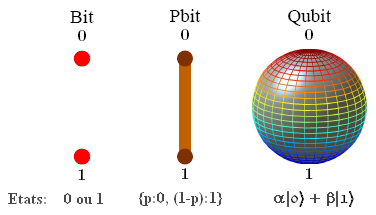
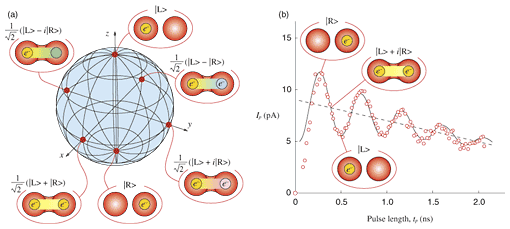
A single qubit can be described only using complex numbers. Where a classic bit can be either in a state (1) or (0) , a qubite can perform these both states simultaneosly at a certain degree of probability. It is said that a qubit can perform also two superpositions of these basic states.


It can be described by


where a and b are complex numbers and they must agree with the following statement:
| a | 2 + | b | 2 = 1

a , b are called amplitudes of probability and a sequence of 8 qubits is called qubyte, a quantum equivalent to byte.


Although it may seem confusing, we can't determine with any measurement the precise state of a or b (whether it is ''more'' in 0;1; or one of the superpositions -> the only exception is when the qubit is directly in one of its ground states - 0 or 1) , we can choose values only randomly and the probability of our guess is in accordance with amplitudes od probability.


when | a | = | b | and because squares of sizes of a,b are always 1, then there is 50% probabilty of finding qubit's state and therefore the result of measuring is absolutely random.

 probability illustration:


The next problem is that the sole measure affect the state of qubit and change it to something else - this phenomena is called colapse of wave function.

As a result of the scientific facts above - we can say that qubit can be in 0 and 1 at once and therefore modern supercomputers would be able to compute exponentially larger amounts of data than are today's conventional computers.


In conventional computers, transistors store information on the basis of whether they are on or off. In the experiment, qubits store information in the form of the orientation, or spin, of an atomic nucleus or an electron.


Of course, there is a catch. The qubits need to be ''entangled''' at subatomic level in order to function(store information) Even if two qubits are extremely far from each other, they need to change one another in a case that one is affected by some impuls from outside. And yet scientists have found unimaginably difficult to keep qubits in entanglement for a longer period of time both in the name of energy and still, lack of sufficient technology.

Ultimately, some people view this experiment as very promising in the future when others say this is a neat scientific discovery, but it is very unlikely to be put into computer reality ever.

But the future is always uncertain! I personally take sides with this technological innovation of tommorow! :-)
 

sources :
http://www.nytimes.com/2011/01/25/science/25spin.html?ref=science
http://cs.wikipedia.org/wiki/Qubit
http://neel.cnrs.fr/spip.php?rubrique481
http://www.ipod.org.uk/reality/reality_entangled.asp
https://www.ntt-review.jp/archive/ntttechnical.php?contents=ntr200801sp4.html
http://www.astrosurf.com/luxorion/ordinateur-quantique.htm
http://www.openclipart.org/detail/qubit-bloch-sphere-by-gcross

Sunday, January 2, 2011

Wanna eat flawless and perfect chocolate?

Everyone loves chocolate. I don't know anyone except those with allergy problems who could with a light heart say: ''I hate chocolate.'' Known as the sweet which makes people fat but also as a medicament which can have beneficial effect, chocolate is with no doubt one of the most popular sweets in the world.


Scientists have concluded that the chocolate is healthy and have positive impact on one
's neural network mainly due to the number of theobromines, phenylethylamines and  flavonoids in it.


                                                         phenylethylamine


                                                   theobromine


                                               types of flavonoids

Chocolate is also known as a stress-releasing medium or aphrodisiac. Moreover, chocolate is said to have salutary effect to one's coronary system as much as a alleviator of coughing. The list of it's effect would be really long. Ultimately, along with its sweet taste that's all why chocolate is sooo popular.


Recently, scientists made an interesting discovery. They have deciphered chocolate's genom. 
Company Mars, maker of M&M and Snickers, dedicated $10 million to this goal two years ago. Teaming up with the U.S. Department of Agriculture and tech giant IBM, the confectioner announced earlier this month that it had cracked more than 92 percent of the genome. Their work is available for free at the Cacao Genome Database, a clearinghouse set up by Mars to aid chocolate research. This work is similar to studies conducted at Pennsylvania State University.


Now after scientists deciphered most of the chocolate genom they can continue the work to manipulate the genes. Options include creating a strain resistant to "witches’ broom," a fungal infection that The New York Times says devastated Brazil's cocoa crop.


 It is believed that this discovery can lead to even more tastier and healthier chocolate! Moreover it could lower the cost of chocolate.

I look forward to artificial,cheap and tasty chocolate! Flawless like anything from a factory :-)
Every chocolate lover must now read more newspapers and look more carefully in shops in some time :-)


sources:
http://ona.idnes.cz/cokolada-jako-lek-nove-vyzkumy-ukazuji-ze-pomaha-i-na-kasel-par-/zdravi.aspx?c=A100325_111544_vase-telo_pet
http://www.csmonitor.com/Innovation/Horizons/2010/0920/Chocolate-genome-could-unlock-tastier-healthier-candy
http://www.mineralfit.cz/diety-a-cviceni-clanek/lekce-ne-prejidani-550/
http://www.mineralfit.cz/zdravi-clanek/horcik-v-lidskem-tele-175
http://www.novinky.cz/koktejl/220623-neodolatelna-cokolada-vedci-usporadali-tazeni-na-genom-kakaovniku.html

Thursday, December 23, 2010

Do you want to lose weight? Eat protein noodles!

I haven't responded to any topic for a long time due to my rigorous everyday program in school as much as in athletics.

   Have you ever wondered how unhealthy it could be, when you eat only pasta? It is said that eating pasta has a salutary impact on one's digestive tract. However, pasta has a very high energic value. This problem together with the fact that a lot of people eat a lot of pasta make scientists believe that pasta cause a much of the obesity in the population.


Let's look at this problem in a more chemical way. What's pasta made from? Well, it's made from grain. And grain consists a very much of carbohydrates, which are very important source of the energy.
  
     As we are aware of metabolic pathways, Glucose is the product of catabolic processes of more complex carbohydrates, like a starch. If people were eating only as much food as their bodies needed for survive, eating pasta wouldn't be a big problem. But it is widely known that we eat much more than we actually need and therefore food with high energic value is not requisite today. It would be shrewd to eat more proteins, because they don't possess such a high percentage of transformation into fats like carbohydrates do.

So there is a need for a change and I have found a very interesting solution. Don't eat ordinary pasta, eat protein noodles instead!


 Scientists invented some time ago a new type of pasta: Protein pasta, which mainly consists of proteins rather than of carbohydrates. This improvement has many effects:  with replacing pasta for protein noodles as one of the main food of a day, one can significantly reduce superfluous energic value of nutritives. 


Protein noodles are made from egg whites enriched with fiber. They are a good source of animal proteins and lack gluten. Protein noodles don't consist of any added sugar, fat or conservatives together with any redundant salt. Thus, they are proper to eat for diabetics, people with high cholesterol and for people on a gluten-free diet. 


With only 28% energic value of normal pasta, protein noodles seem to be very promising for reductive diets.

The only thing remaining to solve is the taste :-)


Sources:
http://www.novinky.cz/domaci/220062-cesi-vynalezli-proteinove-nudle-mohou-pomoci-ke-zdravejsi-vyzive.html
http://funhealthclub.com/world-pasta-day-the-day-of-the-dough-for-obesity.html

Sunday, November 21, 2010

Creating antimatter - way to enlive StarTrek?

     Recently, scientists from European organization for nuclear research (CERN) in Switzerland conducted an experiment in which they successfully created antimatter for 0,1 second. This time was long enough to study it and take pictures of it. It was just 38 atoms of antihydrogen which were made stable for a very short time in vacuum. As you might have known, antimatter is exactly the same as matter but with one exception: it has reversed spin of its electrons. Therefore, it should have very different behavior, but this is still the subject for further studies.


You might now ask: ''Why didn't scientists take up this experiment before?'' Well, the answer is pretty easy- When antimatter meets matter, there is a phenomena called : ''Anihilation of matter'' by which is both matter and antimatter destroyed and huge amount of energy is released. So, there is a need to create a pretty good vaccum in order to eliminate this phenomena. (I hope you know from physics that creating a COMPLETE vacuum is impossible, like creating perpetuum mobile)


There is a big question about antimatter, because it casts doubt on a widely-accepted theory of creation of the universe : The Big Bang Theory. Ultimately, scientists agree that by the Big Bang theory was created exactly the same amount of the matter as of the antimatter. The question is: why the antimatter disappeared or it is somewhere really well hidden from us? The nature probably chose to do so, but we don't know why.


This experiment is a big step for nuclear scientists, because it has opened way for comparison of the matter with the antimatter. This can have further effects, because with the knowledge of the antimatter,we could better understand to our universe.
....
Also, it is good news for every fun of StarTrek. Generally, in StarTrek during year 2063 was invented a new type of engine, which could reach a speed above the light speed limit. This engine was called Warp engine and its fundamental part was connection between matter and antimatter resulting in Anihilation and big energy gain.
The picture above is a Warp engine designed by some Star Trek fun.
Hopefully, with this engine begin we travelling the space more efectively, probably meeting UFO or other extraterrestrial life :-)


Sources :
http://www.nsf.gov/od/lpa/news/02/images/mirror-matter-big.jpg
http://press.web.cern.ch/livefromcern/antimatter
http://www.lcarscom.net/warp1.gif Czech newspapers: Mladá Fronta Dnes